

Introduction
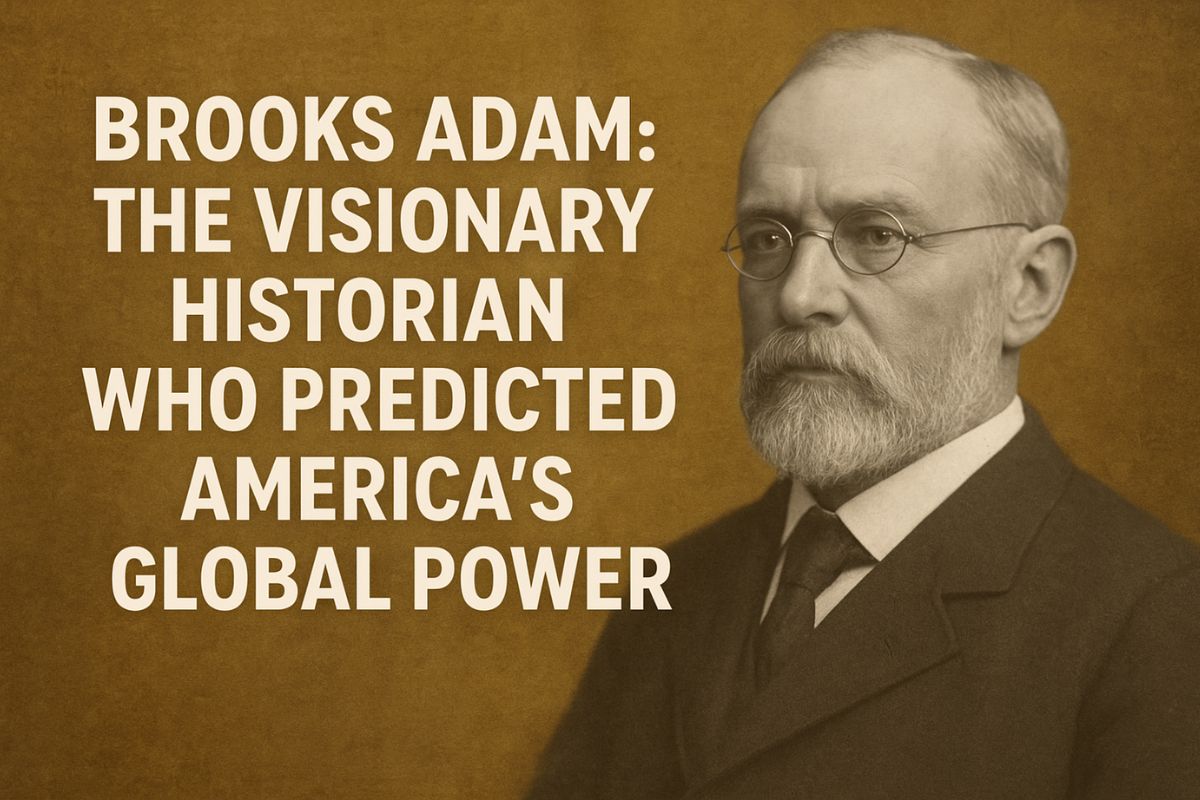
Among the most influential yet often overlooked thinkers in American history, brooks adam stands out as a bold voice who challenged traditional views of civilization, economics, and democracy. Born into the famous Adams political family, he chose not to follow the path of diplomacy or elected leadership like his ancestors. Instead, he devoted his life to studying how nations rise, how they fall, and how economic power shapes global dominance. His writings did not merely interpret history—they predicted it. With remarkable accuracy, Brooks Adam foresaw the economic supremacy of the United States at a time when Europe controlled most of the world’s financial power. Today, in a fast-changing global economic landscape, his ideas feel more relevant than ever.
Early Life and Influential Heritage
A Family Shaped by Leadership
Brooks Adam was born on June 24, 1848, into a lineage of American presidents and statesmen. His grandfather was John Quincy Adams, the sixth President of the United States, and his great-grandfather, John Adams, was the nation’s second President. Being raised in one of America’s most intellectually powerful families exposed him to political ideas, discussions on governance, diplomacy, and debates about the future of the nation.
Education and Shift Toward Scholarship
Brooks Adam graduated from Harvard University in 1870 and briefly practiced law in Boston. Unlike many scholars of his time who remained rooted in academic positions, he traveled extensively, observing economic patterns in different countries. These observations laid the foundation for his most influential writings, where he connected economics, politics, and civilization in a way few thinkers had ever attempted.
Brooks Adam and the Theory of Civilization Cycles
Understanding The Rise and Fall of Nations
Brooks Adam believed that every civilization experiences natural cycles driven primarily by trade, economics, and the concentration of wealth. He stated that:
Economic centers of the world continuously shift, causing power to move from one civilization to another.
His most recognized work, The Law of Civilization and Decay, explored how excessive wealth weakens societies. According to him, when trade shifts from one region to another, nations that once led global affairs eventually collapse.
Trade as the Engine of History
Unlike historians who focused on wars or politics, Adam saw economics as the true driving force behind human development. He argued that:
- Societies grow powerful when they control trade.
- Wealth concentration leads to internal decay.
- When financial control moves, civilization’s center moves with it.
This economic-driven theory would later inspire sociologists and political analysts worldwide.
Prediction of America’s Economic Supremacy
A Visionary Beyond His Time
In his book America’s Economic Supremacy, Brooks Adam predicted the rise of the United States as the world’s dominant economic force. During his lifetime, Europe was still the center of world power. Yet he wrote that the future belonged to America, not because of military might, but because of economic strength, industrial capacity, and a growing internal market.
A Look Into Modern Reality
Today, America stands as a leading global superpower. Adam’s predictions are viewed as prophetic because he identified critical economic trends—long before they became visible to most policymakers or scholars.
Critique of Democracy and Wealth Concentration
Examining the Risks Within Democracy
In Theory of Social Revolutions, Brooks Adam presented a strong critique of democratic systems. He argued that when private individuals accumulate extreme wealth, it creates a power imbalance:
- Government becomes influenced by wealthy elites.
- Wealth does not take responsibility for governance.
- Democracy becomes vulnerable to instability.
Relevance in the Modern Era
With today’s growing economic inequalities, corporate influence, and political lobbying, Adam’s critique mirrors current debates surrounding democracy and capitalism. His ideas provide valuable insights into how societies can protect democratic values while balancing economic power.
Intellectual Legacy and Lasting Influence
Inspiration for Future Scholars
Brooks Adam inspired economists, historians, and sociologists who later studied how markets influence political power. His concept of shifting trade centers helped shape modern geopolitical economic theories.
A Thinker Who Connects Past and Future
Although not as publicly celebrated as other members of his family, Brooks Adam earned his place in history by offering ideas far ahead of his time. His works continue to be studied by researchers exploring global power transitions, capitalism, and the decline of civilizations.
Conclusion
Brooks Adam was not a politician, yet his influence on how we understand global power is undeniable. His theories about the cycles of civilization, the dangers of wealth concentration, and the rise of the United States as an economic leader reveal the mind of a brilliant historian with extraordinary foresight. Today’s global landscape reflects his predictions, proving that his ideas remain not just historically significant, but essential for understanding the future.
Brooks Adam’s legacy teaches us that nations thrive not only through governance or war, but through economic wisdom—and that those who control trade ultimately control the world.
https://blognova.co.uk/